Tulbagh’s Church Street must be the most beautiful street in South Africa.  Devastated by an earthquake in 1969, it was painstakingly restored and the 32 buildings comprise the largest concentration of National Monuments in a single street in South Africa, all of which are in daily use for you to enjoy.  You can stay, dine or shop in them and experience life in a bygone era.

Rows of Cape Dutch buildings in Tulbagh's Church Street

Rows of Cape Dutch buildings in Tulbagh’s Church Street

Self-catering accommodation, restaurants and shops occupy the upper side of the street while the lower side has the leiwater channel with further heritage buildings and garden erven.

Self-catering accommodation, restaurants and shops occupy the upper side of the street while the lower side has the leiwater channel with further heritage buildings and garden erven.

Walking down this spell-binding road, I wondered why Tulbagh hadn’t become nearly as popular as Franschhoek, for example.  It’s not that much further from Cape Town — 120km (124km if you go via Riebeek Kasteel) vs Franschhoek’s 80km.  (It is the exactly same distance from Cape Town as Hermanus.)  Both towns are, to most intents and purposes, at the end of a road.  Tulbagh has the edge when it comes to heritage architecture and was already home to premier wine brands when Franschhoek was still a sleepy fruit-growing village 30 years ago.

Well Tulbagh didn’t have an Arthur McWilliam Smith and a municipality which grew the attraction and the town’s brand like Franschhoek did.  Yes, the number of really great accommodation establishments in the Tulbagh area has grown (click here for more) and it is a very popular wedding location, but many visitors will spend their entire stay at their farm accommodation because the attraction of the town has not kept pace with what tourists want.

The main road, Van der Stel Street, doesn’t cut it.  It’s far wider than it need be and the lower side — which has some fine old buildings and several eating establishments — has no sidewalk whatsoever!  To walk along this side of the road, you need to zig-zag between parked and parking cars.  It is a lousy pedestrian environment and not at all conducive to retail and hospitality activities.  Witzenberg Municipality gets a #Fail for commonsense and pedestrian safety.

Imagine widening the pavement so that eateries could spill out, creating more buzz, while still allowing pedestrians to walk up and down deciding where to stop next.  How long will it be before the number of eateries along that side of the road will double?  How long before the town of Tulbagh becomes known as a nice place to be, in addition to the attraction of heritage architecture?  This is not rocket science!

For a long time, Tulbagh has focused on the legacy of the earthquake and the restored buildings… but that’s not what people want.  They want food and wine destinations; they want scenic beauty and quality pedestrian environments.

More recently, the area has been branded as the Witzenberg Valley — encouraged by Witzenberg Municipality which comprises the towns of Tulbagh, Wolseley and Ceres — which is not a valley at all since it has the stunning beautiful Michells Pass between Wolseley and Ceres!  The actual Witzenberg Valley stretches north from Ceres.

Wolseley and Ceres are not tourist towns and are not likely to become ones for a long time, although their surrounding areas do have a number of tourist attractions.  Ceres is best known as the Western Cape town to visit to see the snow after heavy snowfalls.

Tulbagh is best placed to become the main tourist town for this region and has the strongest brand by far: it just needs to be developed.  Take a leaf from other areas — Constantia once only included a few estates but Constantia Valley now includes Tokai and rural Bergvliet.  The Franschhoek tourism area now includes estates and tourism businesses which are actually in Groot Drakenstein, Simondium, Paarl and Stellenbosch.

CapeInfo believes it makes more sense to market Tulbagh and Wolseley together — it is a contiguous wine-growing area and offer synergistic and complimentary tourism products.  Yes, they are close to other attractions at Riebeek Kasteel (38km away and en route to Cape Town) and Ceres is a 12km drive over Michells Pass from the Wolseley side of the valley.

What do you think?  What destination branding will benefit this area the most?  (Municipal areas are not destinations — click here for more on that.)  What does the town and region need to do to become an aspirational tourism brand?

Let’s start the debate!


Posted in #gamechanger, Winelands | Tagged , , , , | 3 Comments
The R44 north -- emerald green landscapes and startling skies.  Winter is when to go north from Cape Town.

The R44 north — emerald green landscapes and startling skies. Winter is when to go north from Cape Town.

Posted in Western Cape | Leave a comment

They are the catalysts that can lead to significant changes — and for the purposes of this blog, we’re exploring how tourism can become a far bigger industry, providing many more meaningful, upwardly-mobile jobs, very quickly.

There are people and businesses, some of which we’ve met in the past few months, that have an impact that is extraordinary.  And there are others, notably local government, who just don’t get what tourism is all about.  Tourism has grown in spite of them.

But the gamechanger with the biggest negative impact on tourism is undoubtedly the Department of Home Affairs new visa regulations.  If the DA is correct, SA could see over 536,000 fewer foreign visitors, leading to a loss of 1.5 million tourism industry jobs.  The estimated cost to the economy is R8.6 billion.

We’ve added a new category to Travels with Beezus — Gamechangers.  You can read all the posts in that category — click here.

Posted in #gamechanger | Leave a comment
Beezus at the Nelson Mandela Capture Site outside Howick

Beezus knows this is a special place, at the Nelson Mandela Capture Site outside Howick.

This is one of the most inspiring artworks of recent memory in South Africa.  It gripped me the first time I saw photographs of it.  I just had to visit it when I realised it is just outside Howick in KwaZulu-Natal, where I spent one night on our travels.  I met Nelson Mandela five times, and he will always be unique among the many very special people from around the world I have been privileged to meet.

What makes this photo special is the way Beezus reacted.  There is quite a walk from the car park — not a Long Walk by any means, but enough to make one think about the Long walk to Freedom.

Beezus wasn’t on his leash, and seemed to sense the gravitas of the place.  He walked up to the inscription, as though looking at it, and then took a few steps back… and just sat there, looking at the artwork.  For maybe 15 minutes while I reflected too…

On how different South Africa would be with a Mandela still at the helm:  Xenophobia would be nipped in the bud before it became angry.  A proper discourse on statues would take place before chaotic elements had their way.  Mandela was a Statesman… his successors are nobodies, less than nobodies…  At least we experienced a Statesman, and can hold every future leader up to that benchmark.

What made this visit special was the walk back.  There’s a hoarding around new buildings underway which carries stories about what’s being built, and a photo of Madiba.  Beezus walked past these and then stopped… and looked back at Madiba’s photo…  gave a yap and then continued on his way.  He knew what this was about, and that places him ahead of most of humanity.

Travels with Beezus is the successor to Travels with Akela (the wolf who died in 2012), which was inspired by John Steinbeck’s literary classic: Travels with Charley — in search of America.  Steinbeck was saddened by what he found in the USA, as have I in SA.  Government is failing us, increasingly, day by day.

This post marks the end of the travels for now, and I must catch up on the stories waiting to be published from this trip.  Follow CapeInfo on Facebook to see all of them.

Posted in Bucket List, KwaZulu-Natal | Tagged , , | Leave a comment

Dear Derek,

The Tourism Indaba which opens in Durban tomorrow will be your first as Minister of Tourism.  You could make it a game-changing Indaba if you announced your intention to introduce a Tourism Charter, which the mayors of all cities, towns and villages need to sign.

Tourism needs to be put at the top of the agenda because nothing else can create as many jobs and create as much upward economic mobility. Tourism creates opportunities and improves environments — and many towns need to improve their environments.

One good way to measure whether municipalities are serious about tourism is how they spend their budgets.  Does tourism receive more funding than the mayor’s office, for example?  Surely tourism is sufficiently important to warrant a bigger budget slice than the mayor’s salary and his expenses (entertainment, travel, etc)?

A Tourism Charter should focus on the fact that Tourism is an economic activity, with measurable benefits.  So the wider economic agenda must trump political and personal agendas.

Municipalities must commit to public/private partnerships to run tourism in their towns, where tourism organisations are run by the private sector and supported by the municipality.  (Exceptions do prove to rule, and the only exception I’ve encountered where a municipality does understand how to drive tourism is the Baviaans Municipality at Willowmore, Eastern Cape.  And government wants to undo that good work.)

A Tourism Charter should be easy to make happen.  SA Tourism could stop marketing destinations where mayors don’t sign and commit to the Charter.  And funding for all those vanity projects — which primarily make the mayors look good — from Municipal Infrastructure Grants could be allocated more selectively.

Government does have the means to drive tourism, but is it capable of doing that?

Posted in #gamechanger | Tagged , , , , , | 3 Comments

In 2012, I interviewed the local manager of Stanford, part of the Overstrand (Hermanus) municipality.  I never published the interview because it was such an embarrassment.  I did share the content with Overstrand’s mayor — who just sat with her head in her hands and then asked for it in an email, which I did.  I don’t think anything ever came of it.  (Click here for the rest of that story.)

After looking at municipalities around the country, I think it’s time to share that as one of the examples of where municipalities get things badly wrong.

Politicians & bureaucrats are often drowned by their own prejudices & inadequacies
These are some of the points the manager made and comes from my email to the mayor:

  1. The UCT Landscape Architects’ project proposals for the link between Stanford (affluent) and Stanford South (poorer) is a non-starter “because Stanford does not need first world solutions.”
  2. She laments the Anglification of the village and yearns for the boere dorp (Afrikaans farming village) it was.
  3. The 1000 people in Stanford cause more problems than the 7000 in Stanford South, to such a degree that she can’t take proper vacations since no-one else from the Municipality wants to stand in for her.
  4. She’s against a lively street scene with pavement cafes because she doesn’t want people to walk past and look at her “bord kos (plate of food).”
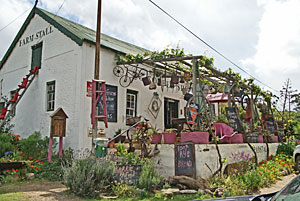
  5. The Napier Farm Stall is such a compelling stop that it has introduced more people to the village than anything else.

    The Napier Farm Stall is such a compelling stop that it has introduced more people to the village than anything else.

    She’s against the owner of Evergrine Farm Stall being encouraged to create a feature at the entrance of the town to attract people to stop, like Napier Farm Stall, “because no self-respecting Afrikaans family would stop with all those goeters (things) hanging outside.”

In another town in 2002 when Keith Jordaan was municipal manager at Cape Agulhas Municipality, he asked me what I thought could be done with Napier’s dreary main road — trees can’t be planted in the sidewalks.  I suggested that, because the village doesn’t have a parking problem, half of every third parking bay should be used to plant an avenue of trees.  I discussed this with David Jack, former Cape Town City Planner and MD of the V&A Waterfront, a close friend who’s opinion I always value and who has a farm just outside Napier.  He thought it was a great idea and asked me to convey to the municipality his offer to pay for the trees.

It never happened because the municipality’s head of services said the leaves would make too much mess.

Politicians and officials are civil servants.  They need to stop being arrogant and start being civil and providing better service.  They are servants of all the people, and not just their political party or prejudices.

Municipalities are just too good at killing the attraction of their town centres
Drive around South Africa and if there is one thing that impresses you — in a negative way — it will be a prevalence of dirt and disrepair in many town and village centres. Many municipalities are doing an appalling job.  Many just don’t realise how bad they actually are.  These politicians and officials are actually stealing their salaries.

In Winterton (Kwazulu-Natal’s Town of the Year in 2013) and Willowmore (Eastern Cape’s new tourism star) the cleaning up of the town centres was initiated by two women who tackled the job and persisted against all the odds.  It is their achievements that is enabling these towns to become tourism towns.  They are the stars that tourism departments and SA Tourism should be applauding and encouraging as role models.  (Share this story on Facebook, Twitter, etc. if you agree!  More about these people and towns will be published soon.)

Municipal officials rarely consult people with real knowledge because they are frightened that their lack of knowledge will be shown up.  Offers of assistance are turned down for the same reason.  Very few towns have professional town planners on their staff and I doubt that many have ever heard of the disciplines of urban design and landscape architecture. The result is town centres which are being damaged for many, many years to come… impacting badly on those towns as tourist destinations.

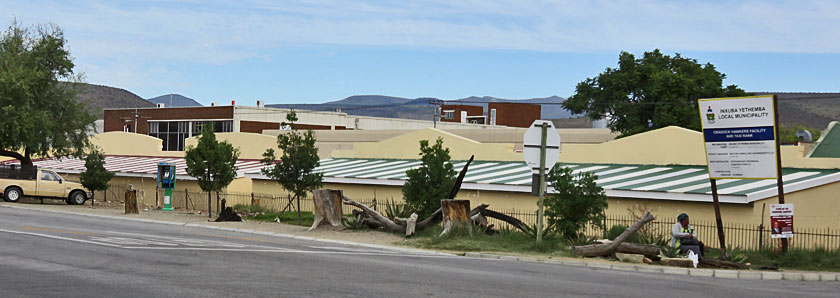
New premises for informal traders in Cradock

Town centre streets need retail density to be attractive & successful. In Cradock, the municipality’s new premises for informal traders presents a dead facade hundreds of metres long along the town’s main street. Watch the litter pile up alongside the back of those new buildings…

Solutions for managing town centres better will be published soon.

“Tourism is a nice-to-have — not a necessity”.
This usually comes up when budgets are discussed.  The fact that a town might have an unemployment rate of 80% and all that can save it is job creation isn’t at the top of the agenda.  Enabling economic upward mobility can be achieved better through tourism than by anything else.  Do politicians and officials really care about this?

Anyone who says this should be publicly condemned as an idiot.

Tourism is too white; it needs transformation
The people who usually say this drive Audi’s, BMW’s or Mercedes Benz’s.  Shouldn’t they be driving Tata’s or something to show support for other emerging nations?  They usually stay in the most expensive hotels they can get away with.  Shouldn’t they rather be supporting emerging businesses and make real contributions to local economies?

How many people know how Holiday Inn became to be a global brand?  It was because Americans wanted to stay in American hotels wherever they travel abroad.  So it’s understandable that thousands of tourists visit Soweto every month… but they stay in Sandton or Rosebank.  Tourists want their comfort zones and, while they do make short excursions to what is foreign and exotic, they want to go back to being among what is safe and familiar.

If government is so committed to transforming ownership in the tourism sector, why did it allow the sale of Protea Hotels — Africa’s largest hotel group — to foreign owners?  It’s now owned by Mariott from the USA.  Why did it sell the V&A Waterfront — which it once owned — to Dubai World, before local interests bought it back?  Commitments are shallow when money talks.  So when municipalities target small, existing tourism businesses, it shows hypocrisy.

Have all levels of government established a tourism ethic in South Africa?  Surely not, when our renown Blue Train needs armed SAPS police riding shotgun on it to protect it as it travels through stations.  At a Transport Portfolio Committee meeting at Parliament some years back, I heard a member of parliament ask, in all seriousness, why all South Africans can’t travel on the Blue Train after hearing that the train is frequently stoned while passing through stations!

Municipalities are tasked with managing tourism as a local function, and most are failing abysmally.  Most do not have a tourism ethic.  Most don’t have a business plan.

Tourism is a business and it is totally controlled by market forces.  No politician or bureaucrat can change those market forces; but they can kill the business.

Municipal tourism offices promote the attractions they want to promote… not what tourists want
In Bethlehem (Municipality), the tourist brochure covers a whole list of attractions… which are hardly attractions at all.  The town’s biggest attraction is arguably Lionsrock Lodge & Big Cat Sanctuary which is not promoted at all.  This happens all over South Africa.

And then, of course, there’s the stupidity of promoting municipalities as destinations… click here.

Political agendas are the death knell of tourism.

“We need to have a meeting”
Wrong!  Unfortunately, municipal officials believe that their main role is to hold meetings, travel to neighbouring towns, claim transport and subsistence allowances, and give the appearance of being busy… and usually unavailable.

How many are judged by key performance indicators and what was actually achieved, month by month, day by day?

And then every time a new local economic development or tourism manager is appointed, a new business plan needs to be prepared… so nothing is ever implemented and carried through.  More millions wasted.

Municipalities are stealing funds earmarked for tourism and tourism-related organisations
I’ve encountered dozens of municipalities who either ignore funding agreements with tourism organisations and fail to meet their obligations, or receive funding from district municipalities or provincial entities intended for tourism-related organisations, but never pay it over.  It’s time the national tourism and local government ministers did something about this.  Come on Derek Hanekom and Pravin Gordhan!

And there are few places for tourism organisations to turn to for assistance.  Even in the Western Cape.  The new tourism team at Prince Albert, the gem of the Karoo, say they haven’t been able to get to build a relationship with their municipality.  The municipality won’t send a representative to attend their meetings.  Attempts to get help from Wesgro, the provincial tourism authority, met a brick wall.  An agreement to funding was forthcoming but they were then told by Wesgro it was a mistake.  And a meeting with Wesgro’s marketing executive was arranged, but she never arrived.


Want to read about a small town’s tourism organisation with a real tourism plan… and a budget of R51 million for the next three years?  Click here.

Want to read about South Africa’s best mayor?   Click here.  (If you know of a better mayor, please let us know.)

Posted in #gamechanger | Tagged , , , , , , , , , , , , , , | 2 Comments

Municipalities around South Africa are wasting millions of rands promoting themselves and killing tourism in the process.  No-one gives a damn about what municipal area they are visiting – and why should they?

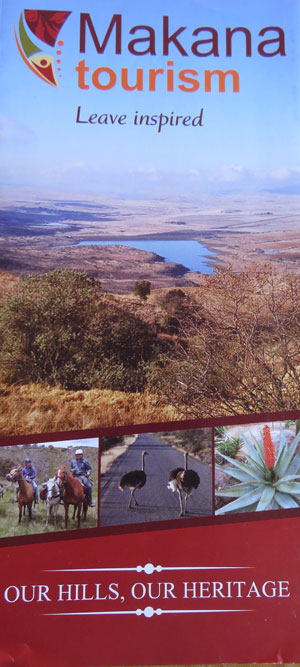
Makana Tourism brochureIf you visit a tourism trade show and see the brochure alongside, would you pick up a brochure for a place called Makana?  I certainly wouldn’t.  But I would if it was for a city called Grahamstown — yet all Grahamstown’s literature is branded as Makana – the name of the municipality.  This is madness.

Makana Municipality’s only claim to fame is that it is technically bankrupt.  And so in arrears in its payments for electricity to Eskom that the electricity supply to the whole town is being turned off in May.

The Makana brand is a non-entity (but rather a liability) compared to the towns it is intending to promote.

In East London – sorry, Buffalo City – Phindile Mbonwa, at the municipality’s department of local economic development & tourism, complained that SA Tourism only markets Cape Town and the Kruger National Park, when they should be marketing Buffalo City too.  Well that’s a little difficult when Buffalo City doesn’t exist on any map, the airport is called East London and so is the Post Office!

She said that the names of East London and all the other towns in the municipal area will be changed to Buffalo City – after the river that runs through East London.  That may be the plan, but marketing a politician or bureaucrat’s say-so is never going to work.

Driving into East London from Port Alfred, I was impressed at the excellent signage to the tourism info office… until I got there.  The prime beachfront offices are now occupied by the department of health’s call centre and tourism had vacated the premises some while ago.  It seems East London, or Buffalo City, have a long way to go before they get their act together.

In Bloemfontein, or is that Mangaung, I got lost because Google Maps doesn’t recognise some of the new street names.  This just emphasises how municipalities don’t give a damn about users… and tourists.  And the Mangaung tourist info office only opens during municipal working hours, rendering it useless for most tourists.  And the map outside the office… still shows the old street names!  I wasn’t able to find a map of Bloemfontein, or Mangaung, anywhere.

So when it comes to tourism Makana, Buffalo City and Mangaung, you are a total failure!  But so are most other municipalities.

Posted in #gamechanger | Tagged , , , , , , , | 9 Comments