As winner of the Best Village Award, I’ve tried to understand the dynamic of Stanford, and what it needs to get even better. An important element here is the role that the municipality plays — in this case Overstrand Municipality which is responsible for Stanford as well as Pringle Bay, Betty’s Bay, Kleinmond, Hermanus and Gansbaai.
Of course, one picks up the inevitable grumbles in Stanford as one does in any town. But there’s no denying — which is evident to anyone driving through the area — that few municipal areas are as well-maintained. Basic service delivery here is of a very high standard but then there’s little excuse for getting that wrong. What is more difficult is having a shared vision of where everything is headed.
Stanford’s lifeblood is tourism which is derived from its status a heritage village. Destroy its architectural fabric and it will lose all appeal.
A visit to the local municipal office is where my rosy-eyed optimism started going very awry. Writing this became a challenge and it’s ended up being a very different story to what was envisaged at the outset. But all one can do is “tell it as it is…”
The meeting with the municipality’s area manager for Stanford was bizarre beyond the extreme. It’s the stuff that would be worthy of a ludicrous satire. A delightful person and probably a capable manager of basic service delivery, the very personal opinions expressed belonged to the dark ages of municipal management. When someone acknowledges having no love of historical buildings and no vision for Stanford in 20 years’ time, yearning rather for the boeredorp (farm village) it once was, one is filled with a sense of hopelessness.
So that’s one interview that won’t be published! For which the Municipality is very grateful!
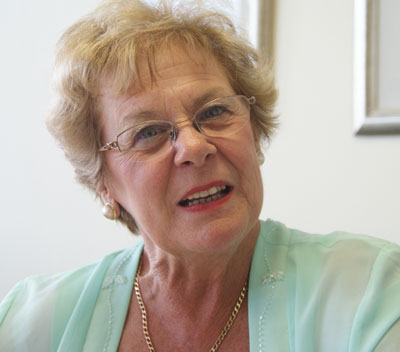
Nicolette Botha-Guthrie, Overstrand mayor
I met the mayor — Nicolette Botha-Guthrie — for the first time at a StanfordInfo function. I was impressed. I was less impressed by the mayoral committee member responsible for finance & economic development (which includes tourism), Ben Solomon. The three of us were standing around a table when I commented that their marketing department’s strategy to get the 90,000 day-visitors to Gansbaai to spend more time in the area was unbelievably poor. Ben responded gruffly that I should never have received the strategy because it’s a work-in-progress. “How can you have a work-in-progress for 10 years, because that’s how long day-trippers have been visiting Gansbaai?” I asked. “Somebody isn’t doing their job.” With a dismissive wave, he indicated he was not prepared to discuss this further. So how’s that for accountability?
Nicolette said I should come and see her so I made an appointment for some weeks later. Public opinion in the area rates her very highly, and I think that Overstrand and the towns are very lucky to have an executive mayor as committed to her job, and the area.
Nicolette’s parking bay at the municipal offices is always one the first to be occupied and one of the last to be vacated — she works very hard! She says she never turns down an opportunity to speak at public functions and she meets with everybody, all the time. She is a passionate, accessible communicator.
She is a mayor for all citizens, she states clearly, not only the DA voters who made her mayor. “We learnt from when the ANC was in power and shut us out of all decisions. We make sure that everybody is involved,” she says.
When I mentioned my concern that started about 10 years ago about the municipality’s corporate culture she jumped up and said, “We have a vision!” fetching a large report. She plonked down the Integrated Development Plan down — “her bible” — and said, “Our vision is to be a centre of excellence!”
Then I asked about an Urban Design Framework to guide development, especially in sensitive areas like Stanford. “We’ve got that too,” she said, “it’s our Growth Management Framework by Urban Dynamics.”
Well… a Growth Management Framework (GMP) is not an Urban Design Framework and, looking at their website, Urban Dynamics doesn’t appear to have any professional urban designers on their professional team (although they offer it as a service). Portion of the report was prepared by ACG Architects but all I got back from a query asking if they have any professionally-qualified urban designers on their team was a read receipt.
The GMP’s chapter on Stanford cannot be described as a vision – it is a glorified zoning plan. It appears that nobody in the community was consulted. Not the Ratepayers, the Conservation Trust, tourism, nor business leaders or any of the local expertise. It therefore does not have any credibility, and is so broad in scope that its usefulness is extremely dubious. The Stanford community have been asking for a local Spatial Framework Plan to guide development only to be told that there are no funds. It would be interesting to know what the GMP cost.
Why’s this important? Urban Design is very complex and critically important. It is a visionary skill and talent and that’s not something a planner — with no design skills – can tackle. Few architects have the capability either.
What is even more serious, says one professional, is that there is no comprehensive environmental management plan for the Overstrand. Houses continue to be approved in floodplains, fire prone mountain slopes, wetlands, sensitive coastal zones, rock-fall hazard areas, etc. putting people’s lives at risk, stretching emergency services, disrupting ecosystems and threatening water catchments – something the GMP did not think it was necessary to address.
Before I left Nicolette, she asked if I would note all my points in an email so they could be attended to. She and Fanie Krige, the communications manager, received that the following morning. A day later Fanie told me it had been forwarded to the relevant managers and he hoped to let me have written replies within a few days. Not a single written reply was received in the ensuing two weeks… Then, after receiving the draft of this story, he wrote to say he had received written responses and forwarded them to me. The relevant points have been added here.
My next meeting was with John Simson,Manager: Building Control Services, to find out about why property owners who want to preserve and enhance Stanford’s traditional streetscapes – its biggest asset – are penalised.
Many property owners want to do the right thing – respecting the street architecture in Stanford by building closer to the street than the arbitrary building line permitted – but face a problem. The local Heritage Committee may whole-heartedly endorsed the plan, and Heritage Western Cape will approve it in one day, but Municipality’s Planning Department required an additional R1400 application fee and eight months to approve the plan – to approve something that should have been the norm in the first place!
The problem lies with the new Integrated Zoning Scheme, which standardised all the individual zoning schemes that existed for each town and village, as if they are all uniformly the same, regardless of the unique environmental and cultural heritage conditions of each settlement. It is a result of the same inane thinking used by paid outside consultants who know little of the area. It was a retrogressive step, now requiring overlay zoning schemes to accommodate the specific requirements of each town, and with which there has been no visible progress. It’s blundering bureaucracy!
Before the Stanford Zoning scheme was proclaimed in 2004, the historical building line was regarded as the norm. One still had to write to ask that Land Use Planning Ordinance’s general building rules be waived, but it was a letter-process rather than a formal application with costs involved. The decision was then made by the Stanford council.
John was very helpful but felt my question needed to be directed to the planning department rather, because this would be addressed — in part — by the new zoning plan, due between April and June this year. But… he said the special zoning overlay Stanford has been asking for since 2003 hasn’t been prepared and, when it is, won’t resolve the issue I raise.
The next two interviews were the least productive, and seemed to take place with an irritated reception and an almost aggressive/defensive atmosphere.
First was Riaan Kuchar, Senior Manager: Town Planning and Property Administration. He confirmed what John had told me and said that several overlay zones will have to be prepared. This could drag on for years.
Yes, legislation is a straitjacket but there must be smarter ways of doing things. I think back to the V&A Waterfront’s Package of Plans approach that I helped with. And I remembered that when Helen Zille became Western Cape Education MEC many years ago, she asked for a lawyer in her office – not to enforce laws but to find ways of doing things faster and better within the law. Is it any wonder that she is admired so?
Riaan made the point that he can’t think of another municipality that has done as much to address environmental issues of every kind for its diverse natural and built environments. He used the example of their appointment of a heritage architect. I corrected him, saying they appointed a heritage planner, which he conceded to. One doesn’t expect this kind of muddled thinking from someone in his position.
He is a planner by profession, having studied at Potchefstroom University (now University of Northwest). He agreed when I said that what’s taught up there is very different to the planning taught at locally. (I experienced the archaic, rule-book approach of Transvaal planners from the Department of Community Development when I worked at the Mitchells Plain Planning Unit in the 1970s.)
I get an ongoing sense that Overstrand does things by the book… with little initiative, innovation and transparency. It’s a route that costs ratepayers dearly in consultant’s fees.
Stanford does not have a parking problem – it has too few feet and too few cars to support the few businesses in town.
My biggest concern is the way that parking is being handled in Stanford. Some years after someone opened a collectibles shop operating out of a garage alongside the house where they let out one room, they received the demand to provide six on-site parking bays!
This is more than a little absurd when; firstly, the municipality has no parking plan for the municipal area. And secondly, the municipal parking area was sold to a developer who was erecting a commercial building! The municipal offices do not comply with their own parking requirements, not the least being the provision of disabled parking. Riaan conceded this.
The parking area referred to should never have been sold as it was a golden opportunity to create a paved village square – a ‘heart’ right in the centre of Stanford. It was a bungled opportunity because of the lack of a vision and an urban design plan for Stanford. I’ve been told that this sale is being investigated by the Public Protector.
Stanford does not have a parking problem – it has too few feet and too few cars to support the few businesses in town. If you look down the main street during a week day, you can usually count the number of cars on one hand. It is ridiculous to apply parking standards used in Cape Town or Hermanus to a small country town – another example of the standardised zoning scheme that implies one-size-fits-all, and a mindless bureaucracy that imposes it.
The municipality’s current policy will destroy all hope for a strong and environmentally-attractive retail core in Stanford, and flies against all sensible urban design practices. Compare what Overstrand Municipality wants for Stanford to what happens in Franschhoek, which thrives!
Some years ago, local architect Guy Whittle and a few others approached the municipality with a proposal for parking around Market Square, which is within easy walking distance of the whole village. What had happened to this, I asked?
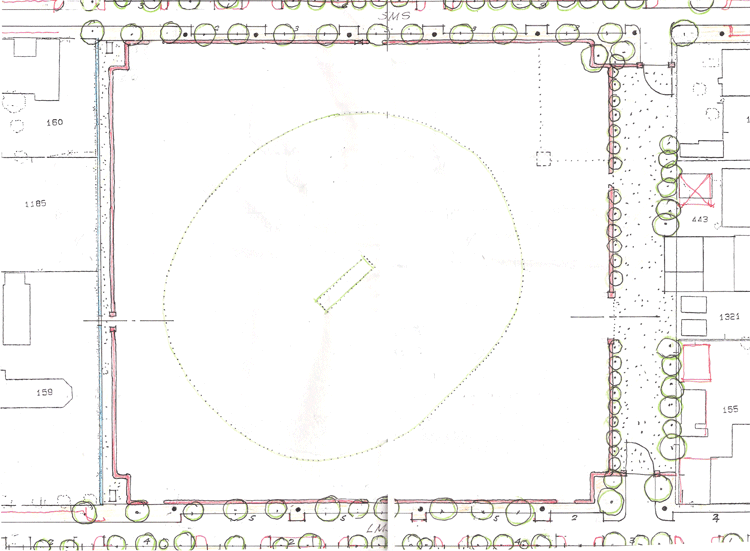
A proposal to upgrade Stanford’s Market Square with parking in the two roads on either side.
One of the comments received after the draft story was sent to the Municipality was from Schalk van der Merwe, Municipal Town Planner for Gansbaai and Stanford:“The redevelopment of Market Square is contentious as the residents are not in agreement about what must happen. There is no plan on the table at the moment as all previous plans were rejected by the community. The idea to develop parking around Market Square, however, is supported by the municipality.” Any change is contentious and it takes leadership and vision to drive change. V&A Waterfront or St George’s Mall would never have happened without leadership. Does Overstrand have inspired municipal leadership?
Back to Riaan: It will still go ahead at some or other stage, but the parking there will be for municipal use and not to alleviate the obligations of businesses. The municipality does allow businesses to purchase parking spaces remote from their premises but, Riaan commented rather smugly, “I can’t see any Stanford businesses paying what it will cost.”
I found his attitude unhelpful and unlikely to ever realise positive and practical outcomes for Stanford. The last straw was when he said, “So go and tell your buddies back in Stanford…” which I found completely unprofessional. Maybe it’s a cultural thing.
Then it was Solomzi (Solly) Madikane, Director: Economic Development. He was just leaving the office when I arrived at the appointed time, and would have missed him had I not been accompanied by Fanie Krige. Unfortunately, this was the only meeting that Fanie did not sit in on.
To get things rolling, I asked him what the main focus areas were for Overstrand’s local economic development. “Why do you want to know?” he asked. “I’m not answering that. It wasn’t in the list of points you raised with the mayor.” I wondered if this was going to be a five-minute interview. Surely that’s a perfectly normal scene-setting question to someone in his position?
So I moved on to criticisms of any evidence of the Overstrand DMO’s marketing plan. “I agree with them,” he said, “there is no plan.” How can a marketing department that has been in existence for ±3 years with a person in charge for ±18 months not have a marketing plan? When will there be a marketing plan? “We’ve asked for funding in the next budget so we’ll have a marketing plan after June,” was the answer.
Surely the marketing plan is the first thing one tackles and, surely, that’s where all one’s budget goes when you start? I wonder what Alan Winde (provincial minister of Finance and Economic Development) will have to say to this.
Given that there is no marketing plan for tourism businesses in the Overstrand, I thought this was the right time to raise the issue of the business property tax that accommodation establishments attract in the Overstrand. This is not the norm in the Western Cape!
In the written replies received after the municipality the draft story, Ben Solomon stated “This approach to B&B’s and guesthouses is not unique to Overstrand Municipality and you will find it almost at all other municipalities.” So I wrote back to ask “which municipalities?” and received the following: “We do not have so much interaction with other local municipalities to answer the question fully, but a quick scan of other municipalities’ websites indicated that similar policies are followed at least at Mossel Bay, Saldanha Bay and Oudtshoorn.”
So how can he make that statement if he can’t back it up with facts? We’re checking this out (and compiling a comparative list of rates and service charges by municipalities) and I think we’ll find that his “almost all” is hopelessly incorrect. What we have learnt is that guest houses in Mossel Bay have formed a trust and are taking their municipality to court on this issue. And it seems that Afriforum will be taking up the battle at a national level.
Overstrand’s rating policy for accommodation establishments was introduced when a standalone Destination Marketing Organisation was established in 2007, as a way to pay for it. The DMO was subsequently abolished and the marketing function taken over by the municipality.
My question to Solly was, “Does the business rating of accommodation properties benefit job creation and investment?” He was unambiguous in his answer that it does not, and went on to say that the business rating for accommodation establishments had been phased out. “No, it hasn’t,” I replied. “Then why has nobody complained to me,” he answered, and undertook to make enquiries.
So, Overstrand property owners who provide accommodation services, the municipal property rates policy is due to be reviewed very soon. I suggest you write to the mayor, your ward councillor, your newspaper and anybody else you can think of to appeal against being treated differently to most other property owners in the Western Cape. And send This email address is being protected from spambots. You need JavaScript enabled to view it.
too so he knows your views!
In the end, the meeting ran the full hour and we left on far better terms than when we started.
So, is Overstrand a centre of excellence? Not by a long chalk. Tourism, the area’s primary economic activity, is not being managed – it can’t be without a marketing plan. And the vast expenditure on consultant’s reports and the awards received does not guarantee excellence. I experienced an unusual – by 2013 standards – culture at the municipality. It’s archly-conservative and relies on its rules more than common sense. It’s lost the pragmatic “boer maak ’n plan”-for-the-public-good approach that characterised the small towns which were absorbed into the larger municipality. Yes, municipal regulations are far more stringent but a metro like Cape Town shows what can be done by working with local citizens. If Cape Town’s City Hall and maybe even the Company Gardens can be leased to the Cape Town Partnership, why can’t Stanford’s Market Square be leased to the Stanford Conservation Trust? Why not work with citizens rather than over them?
For an area so richly endowed in natural and heritage assets, a Peer Review (as was employed at the V&A Waterfront) of the municipality’s plans and vision will help achieve excellence.
Now that’s something that would strengthen Mayor Nicolette Botha-Guthrie’s vision for the Overstrand as a centre of excellence!
***
“Sunshine is the best antiseptic” is a well-known quote from US Supreme Court Justice Louis Brandeis and refers to the benefits of openness and transparency. The citizens of Stanford and their municipality don’t appear to be in the same book, let alone on the same page.
So let the sun shine in… please share your views; hopefully Overstrand Municipality will respond and share more of theirs… in the public domain.