Bea Whittaker — few have worked harder for the village
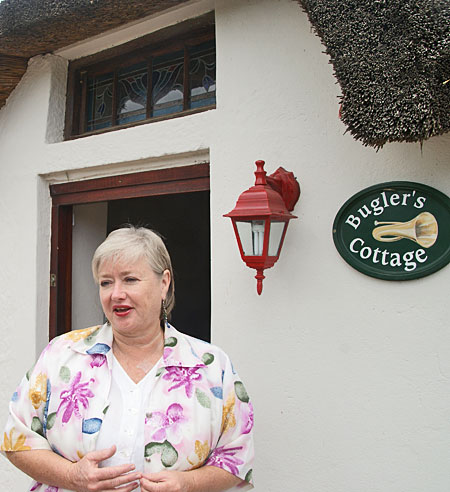
Bea Whittaker has boundless energy and is another stalwart of the various civil society organisations in the town. Today she is the independent member of the ward committee, which means she can’t serve on the committee of any organisation.
But that doesn’t stop her getting involved in anything that will benefit Stanford.
Bea and Basil Whittaker came to Stanford in 1994. “Basil had a plot at De Kelders and we stopped at Stanford en route, admiring the vista to the mountains. I was working at Parliamentary Services in Cape Town and we were thinking about a home for retirement. We took photographs and came back on holiday, and bought our first house on the Market Square.”
Then Marlene (Marlene’s Properties and another stalwart) told Bea that Stanford House was looking for a couple to manage the hotel. Impulsively they resigned from their demanding jobs — and the holiday home became a permanent home. In 1995 she joined Marlene and Mariana Esterhuizen on Stanford’s tourism committee, as they wanted to put Stanford on the map. “It was much more informal then. Things just got done… it was much easier before the establishment of the cumbersome Overstrand Municipality. Now, municipalities are ruled and regulated to inertia,” she says.
In the mean time, in 1996, the Department of Water Affairs (DWA) started the Hermanus Water Conservation Project and Bea, having just started her Milkwood Communications business and having worked for the Department before moving to Stanford and a MBA behind her name, was the ideal person to appoint as project manager for the four-year project. It achieved worldwide recognition as the first successful municipal water conservation and demand management project in the world. She consulted on various other similar projects in South Africa. Her project management and communications skills also took her to Ethiopia in 2000, where the World Bank asked her to draw up a communications strategy for the Addis Ababa water authority – an experience and country never to forget.
But between managing and running her own company with demanding projects, she still had (and still has!) time for Stanford. In 1996 she joined the Stanford Conservation Trust, which was established by Peter de Villiers, David Evans and Mariana in 1991. Stanford’s core was proclaimed a Conservation Area through the efforts of these three Stanford stalwarts.
Next she raised money from the DWA and the Department of Agriculture and more than 70ha of alien vegetation was cleared in the area around The Eye and next to the river in a four year project, employing more than 70 people.
Bea became chair of the Heritage Committee and oversaw the publishing of the Stanford Style booklet. When Stanford turned 150, the committee arranged an entire weekend of heritage events which brought people in from far and wide. The weekend also raised funds for the Historical Stanford on Foot brochure, another initiative of Bea and her committee. (She also helped SJ du Toit with her books on Stanford.) In the last year of her tenure as chair she obtained R80,000 from the Roland & Leta Hill Fund for the restoration of the historic Anglican church. With the church turning 150 this year, she is arranging another black tie event for 20 July 2013 to raise more funds – this time to fix the thatch of the church hall.
She and Basil have for years been involved with the Wandelpad, the brainchild of Mariana Esterhuizen and David Evans, alongside the river. Twice a week the Wandelpad committee manages a job creation team funded by the Department of Environmental Affairs. The “Green Team”, as they are fondly known, has worked wonders along the river, and is regarded as the best team in the Overstrand Municipality. She believes that the riverfront still has to achieve its full potential.
She makes the point that any organisation is only as successful as the person steering it. “He or she must be a lateral thinker who sees opportunities.”
“Stanford people are lovely people,” she says. “We may sometimes fight like mad, yet when trouble brews we stick together like glue. But there is a problem with the village. It attracts people that are exceptionally successful in previous lives, but too gentlemanly to put up a fight with authorities. We need more people who will stick their necks out and get involved.”
Bea wants to get the village going… “but there’s no CEO who acts and gets things done.”
She also bemoans the lack of communication. She writes about ward committee meetings and other issues in every issue of River Talk — the local monthly magazine, which primarily reaches the more affluent residents. But there are many committees which don’t provide any public feedback, and “people want to know what’s happening without being a member of the organisation.” Tourism, Ratepayer and Conservation Trust could share much more.
Some might find Bea pushy or bossy, and I might have been a little intimidated by her had I not discovered that she’s Arie Burggraaf’s sister. Then everything fell into place. I got to know Arie in 1986 when he was appointed to chair a committee to look at opening up SA harbours for commercial development — one outcome of the 1985 Pierhead Festival I organised which regained public access to Cape Town’s docks for the first time since 1966 and the Suez ‘crisis’.
Arie went on to become a director of the V&A Waterfront company and I worked with him until 1999. (The Waterfront story published on CapeInfo is actually based on a paper I prepared for Arie.) Some people found Arie pushy… but the Waterfront would never have happened without him. He saw opportunities and ways around obstacles. And he was tenacious.
Stanford doesn’t know how lucky it is to have someone of Bea’s calibre and commitment.








About time Bea received recognition for all her hard work. I am certainly one member of this community who does value her worth to Stanford enormously.
Thanks Penny! Stanford just has such wonderful diverse personalities. No place better to live!
Bea
Bea is a credit to any association in which she gets involved in. Good to have her around.
Bea, as a relative newcomer, I had no idea about the scope of your work in Stanford. Thank you for your vision and follow-through.