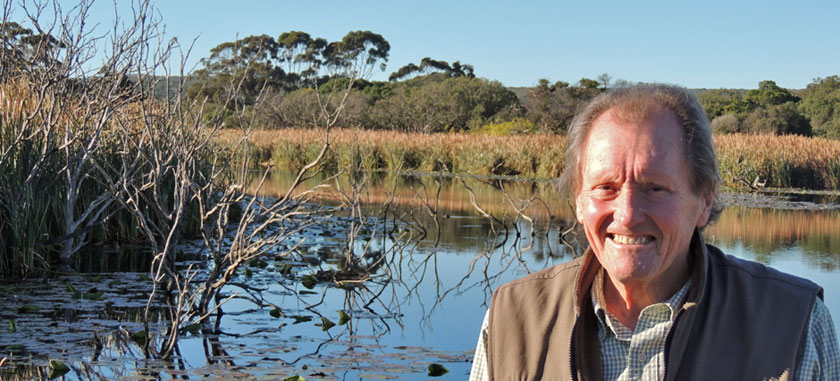
Royd Frith, chair of Stanford’s Conservation Trust in front of the Willem Appel Dam, part of a new Wetlands project he is driving.
Royd Frith arrived in Stanford after Arniston, where he had a weekend house and loved dearly, lost its allure because of beach access restrictions. Royd and Lindsay started looking for somewhere else and Stanford offered tranquillity, charm, diversity in nature, conservation, history… and, most important… birds!
They bought a plot eight years ago and moved into the house designed by Maureen Wolters two years later. The landscaping was designed by Sean Privett, who is also part of the team at Grootbos Private Nature Reserve (read more). “We recreated Eden here,” says Royd and it is one of the warmest and most-welcoming houses I’ve ever visited. The exceptionally-deep veranda encloses two sides of the house and is my new veranda benchmark.
They sold their very successful labour broking company – which they had run together – to Dimension Data and arrived with enthusiasm about what could be done in Stanford.
Royd’s first civil society position was as deputy MD of Stanplan, a section 21 company established to right some of the wrongs in the community. It exposed him to some of the problems that existed in the town at the time and Stanplan failed to achieve expectations. This really is a pity because it was the perfect vehicle to drive change in the village.
Then he threw his energies into the Stanford Bird Club and the Stanford Bird Fair where he became chairman. These have prospered and the Stanford Bird Fair is today arguably one of the notable events on the South African birding calendar.
When he first became chair of the Stanford Conservation Trust and Stanford Heritage Committee, there was rancour in the village over David Abbott’s proposal for a golf estate on the outskirts of the town. When the committee was invited on a site visit to see what was proposed, he was the only member to go. “There is no logic, common sense and vision in Stanford and that still exists today,” he says.
“All the civil society organisations were just going through the motions,” he says, “doing what needs to be done, with no real achievements and no real goals. Tourism is a mess and there are undercurrents in the town – it is completely lacking in vision and empathy. This shows in the tourism and ratepayers’ organisations.”
He accepted that some this this was his fault and, after a breakdown, Martin Ranger took over as chair of the Stanford Conservation Trust. Royd took the decision to change his heavy-drinking lifestyle and gave up alcohol without counselling or assistance. He started to refocus, exploring how the ethos of the village can be maintained and nurtured.
In October 2012 he stepped down as chair of the Stanford Bird Fair and asked new-blood, former advertising executive, Peter Hochfelden to take over, mentoring him for a changeover period. “This has been an unmitigated success!” he says. The involvement of William Stevens (who put Madikwe Reserve in Northwest province together) and sponsorship from his De Hoop Collection is seeing the 2013 Bird Fair reach heights nobody would have thought possible.
Another initiative the Frith’s have started is “Eagle Eyes” — fund-raising to enable the Stanford Bird Club to launch its Bird Life education initiative. The first course has focused on bird identification for disadvantaged primary school learners, which required the acquisition of a number of binoculars.
As Ward 11 Councillor – and still a member of the Stanford Conservation Trust – Royd also tackled the development of the Stanford Wetlands that wind through the village to the Klein River. “Bea Whittaker wrote the motivation for why the wetland should be recognised and it is the finest piece of journalism and motivation I’ve ever seen,” he recalls.
He goes on, saying “And I want this included… Bea is impulsive… but she has done some of the finest conservation work this village has ever seen. She is doing lots to establish a vision for Stanford.”
Selective clearing of reeds has started and the Friths have donated a huge ‘Wendy House’ in the garden of a house he’s just purchased to Overstrand Municipality for use as a bird hide. It’s so large that it’s being converted in four bird hides – two for the Willem Appel Dam in Stanford and two for Gansbaai — at least one of which will be wheelchair friendly!
The redevelopment of the Wetlands offers one element in joining Stanford and Stanford South, the affluent and poorer areas.
With his re-election as chair of Stanford Conservation Trust in April, it’s not “business as usual.” He takes over from Martin Ranger, saying “you won’t find a more solid committee man than he.” But there’s a new team and everything is being run by focused sub-committees.
“Basil Whittaker has been looking after the Wandelpad (path) along the river and it’s never looked better. Guy Whittle is looking at the meent (common or Market Square) and what should be done there. Bernie Oberholzer’s proposals for the Wetlands and to integrate Stanford and Stanford South are being pursued, along with a more attractive entrance to the village. Overstrand Municipality has won the Greenest Town award and funding from this is being sought to green, integrate and grow Stanford’s two communities.”
“Conservation needs credibility. The Stanford Bird Fair needs to become one of the great bird shows of the world. Our ratepayers’ Association is dormant. Tourism doesn’t exist and is our biggest single embarrassment.
“We need a Stanford Partnership where everybody buys into a Vision for Stanford and everybody helps drive it forward.”