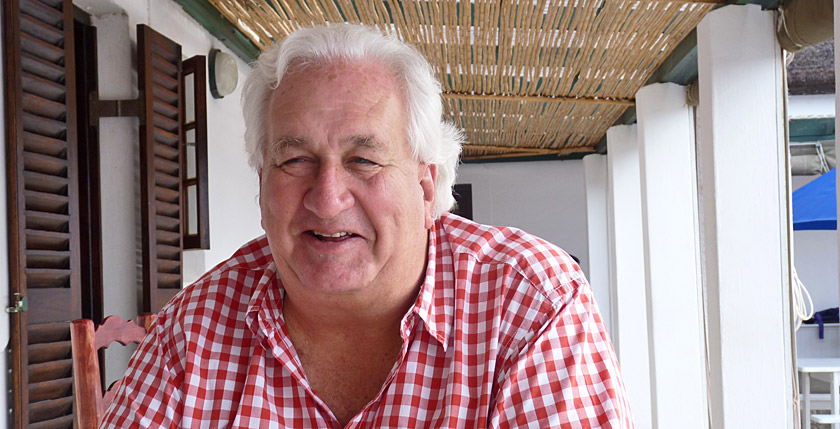
William Stephens, new chair of Stanford Tourism, brings heavyweight clout to the position.

William Stephens, new chair of Stanford Tourism, brings heavyweight clout to the position.

After being away from Stanford for seven months, a number of people wrote – almost simultaneously – to say how much things had changed there.  There was now a spirit of ‘Team Stanford’.  CapeInfo had already noticed this in social media where the little village was making waves, punching way above its weight.

The changes were predictable, but far exceeded what we had expected.  Buoyed by its Village of the Year award, Stanfordians started looking at how to do things better… and, in the process, a can of worms was opened.  Below the veneer, there was some seething dissatisfaction among tourism stakeholders.

Rather than just let things follow their course, a few people got together to plan what would be best for Stanford.  And they pursued that plan.

Between 2006 and 2013, Stanford’s tourism organisation had been served by only two chairpeople, who’d played musical chairs… or kept the seat warm for the other.  There was criticism of favouritism and undue benefits to a small clique.

In planning for new blood to challenge the status quo and quell this dissatisfaction, at the AGM a potential chairperson with no vested interests in the town was sought.  And a proposal for far greater participation through special-interest sub-committees was made.

They were lucky!  A suitable chairperson had made the village his home.  William Stephens had no business interests in the town, but he used it as a base to oversee his De Hoop Collection in the De Hoop Nature Reserve.  This was the first public-private enterprise for Cape Nature and the Western Cape , unlocking value for this astounding UNESCO World Heritage Site.  The De Hoop Collection is a range of accommodation and activity options in the reserve which caters for all pockets.

His previous ventures are routed in tourism, the best-known being his involvement in the development of the 75,000 hectare Madikwe Reserve in the North West province, where a total of approximately 33 lodges have been built.

Prior to the Reserve’s establishment, the whole region consisted of degraded cattle farms that had been expropriated from white farmers,” William says. “Under apartheid, the farms had, in turn, displaced whole communities of tribal groups from their traditional homelands. Most of the wildlife found in the region had long since been hunted out and the whole area was an economic backwater.”  So in this case, “conservation” meant taking the land back to what it was, to give it economic value.  Tourism offered the best way to do this.

One of South Africa’s largest game reserves, Madikwe has the distinction of being one of the few game reserves in the world to be proclaimed purely on the grounds of being the most appropriate and sustainable land use for an area.  The approach towards conservation at Madikwe put the needs of people before that of wildlife and conservation – if conservation is to succeed, then local communities and individuals must benefit significantly from wildlife conservation and related activities.

It was because of Madikwe that Cape Nature awarded William’s company the contract to manage tourism-related facilities at the gem in its portfolio – the De Hoop Nature Reserve.

What William brought to Stanford Tourism as its new chairperson is a wealth of experience – and established contacts and relationships.

Getting all local stakeholders involved and participating was an early goal.  But the call is still out on the success of that.  While talk in the village and on social media is hugely positive about the new tourism committee’s directions, the process of participation hasn’t been without pitfalls.  Small town businesses are not always as professional as one might expect, and there’s always the expectation that someone else must do the work.  Small towns are full of chirping from the sidelines!

Sorting out the village’s website (which still ran on long-discontinued Joomla 1.5 and a bone of contention in the community for its content) was a smoother process.  William’s relationship with Smart Octopus saw that turned around quickly.  (We’d like to discuss these changes in a future blog post.)

Smart Octopus also drove a social media campaign on Twitter –  including co-developing #DiscoverOverberg – which has drawn a large following and promoted the wider Overberg as a destination, although some believe it is more of a mutual admiration society than a tool to reach potential travellers.  But it all contributes to the buzz around the area, and it’s a very cost-effective way of doing that.  (We hope to discuss this with Smart Octopus for another future blog post.)

William and his committee have also encouraged locals to get more buzz going through organising more events, and Stanford Tourism has itself tackled two events as fund-raisers in recent months.

He is keen to start getting more feedback from visitors to the village and is looking at ways of introducing this onto Stanford Tourism’s website.

During the short tenure of the new committee, three of the village’s restaurants have closed down.  One can argue that the operators were just not up to the challenge but it does emphasize the need for towns to start thinking in the same way that regional centres do, when they vet operators for their abilities and resources.  Running a restaurant (or any other business) in a small town is an attractive dream, but it’s also a risky business!  Attracting really good operators is made much more difficult by Overstrand municipality’s town planning requirements.  (And here, CapeInfo will be comparing the differing approaches of Overstrand and Stellenbosch.)  William’s view is that “sometimes things need to break before you can fix them.”  He is actively looking at how best to fix this challenge.

Another remaining challenge is to introduce a “feelgood” attitude into wider public perceptions of Stanford.  “Feelgood” places are respected and admired, and people are keen to return there.  But Stanford is still a racially-divided town – although there many initiatives which aim to bridge those divides.  This challenge will only be successfully addressed when Tourism, Ratepayers, Conservation and everybody else starts working as a team.
 

Posted in Uncategorized | Tagged , , , , | Leave a comment
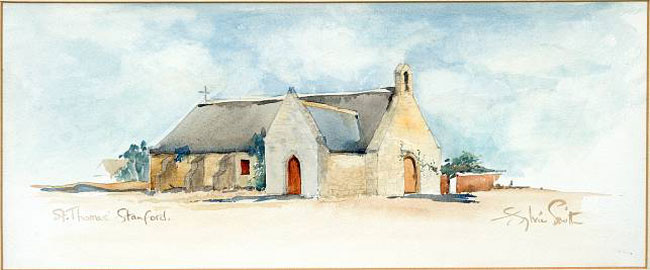
St Thomas Anglican Church

St Thomas Anglican Church

Stanford’s historical St Thomas Anglican church will be celebrating its 150th year of existence during the weekend 19 & 20 July.  The main feature will be a celebration concert on Saturday the 20th from 6 – 8 pm.  This will be a black tie event, with the inspiring A Volonté Trio from Hermanus (who between them play the piano, violin, cello, clarinet, saxophone, accordion and the organ) providing an outstanding programme of classical music.  Guest artist will be local soprano Bea Whittaker, performing, amongst others, Schubert’s Der Hirt auf dem Felsen, a magnificent piece of chamber music for voice, clarinet and piano.  There will also be a short organ piece on the church’s reed organ, which is being restored at the moment and will hopefully be ready by 20 July.

The concert is a fund-raising event to enable the church to fix the thatch roof of the adjacent hall – the original ‘oulap’ school in Stanford.   Tickets are therefore sold at R175p/p, which includes a pre-concert glass of sherry and a post-concert mingle with local wine, soup and canapés prepared by Alex and Tabby from Graze, and sweets prepared by the congregation. Well worth the expense!

Only 100 seats are available, and the event will be publicised far and wide, as well as to everyone who got married in the church the last 5 years!  Tickets are available from Bea Whittaker [(028) 341-0430 or ] or from the Tourism Bureau.

Posted in Uncategorized | Tagged , | Leave a comment
Royd Frith

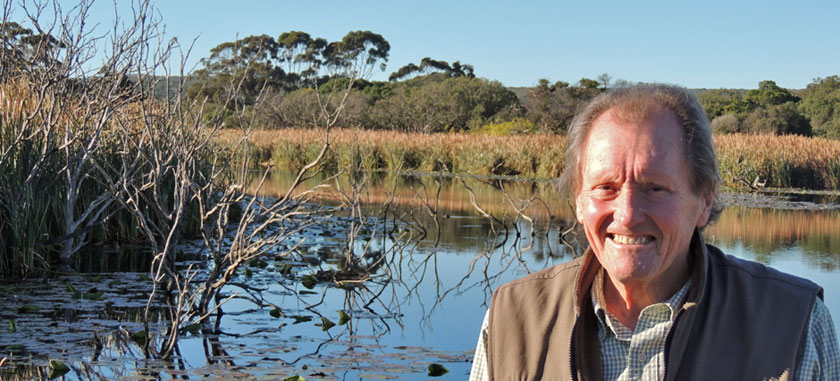
Royd Frith, chair of Stanford’s Conservation Trust in front of the Willem Appel Dam, part of a new Wetlands project he is driving.

Royd Frith arrived in Stanford after Arniston, where he had a weekend house and loved dearly, lost its allure because of beach access restrictions.  Royd and Lindsay started looking for somewhere else and Stanford offered tranquillity, charm, diversity in nature, conservation, history… and, most important… birds!

They bought a plot eight years ago and moved into the house designed by Maureen Wolters two years later.  The landscaping was designed by Sean Privett, who is also part of the team at Grootbos Private Nature Reserve (read more).  “We recreated Eden here,” says Royd and it is one of the warmest and most-welcoming houses I’ve ever visited.  The exceptionally-deep veranda encloses two sides of the house and is my new veranda benchmark.

They sold their very successful labour broking company – which they had run together – to Dimension Data and arrived with enthusiasm about what could be done in Stanford.

Royd’s first civil society position was as deputy MD of Stanplan, a section 21 company established to right some of the wrongs in the community.  It exposed him to some of the problems that existed in the town at the time and Stanplan failed to achieve expectations.  This really is a pity because it was the perfect vehicle to drive change in the village.

Then he threw his energies into the Stanford Bird Club and the Stanford Bird Fair where he became chairman.  These have prospered and the Stanford Bird Fair is today arguably one of the notable events on the South African birding calendar.

When he first became chair of the Stanford Conservation Trust and Stanford Heritage Committee, there was rancour in the village over David Abbott’s proposal for a golf estate on the outskirts of the town.  When the committee was invited on a site visit to see what was proposed, he was the only member to go.  “There is no logic, common sense and vision in Stanford and that still exists today,” he says.

“All the civil society organisations were just going through the motions,” he says, “doing what needs to be done, with no real achievements and no real goals.  Tourism is a mess and there are undercurrents in the town – it is completely lacking in vision and empathy.  This shows in the tourism and ratepayers’ organisations.”

He accepted that some this this was his fault and, after a breakdown, Martin Ranger took over as chair of the Stanford Conservation Trust.  Royd took the decision to change his heavy-drinking lifestyle and gave up alcohol without counselling or assistance.  He started to refocus, exploring how the ethos of the village can be maintained and nurtured.

In October 2012 he stepped down as chair of the Stanford Bird Fair and asked new-blood, former advertising executive, Peter Hochfelden to take over, mentoring him for a changeover period.  “This has been an unmitigated success!” he says.  The involvement of William Stevens (who put Madikwe Reserve in Northwest province together) and sponsorship from his De Hoop Collection is seeing the 2013 Bird Fair reach heights nobody would have thought possible.

Another initiative the Frith’s have started is “Eagle Eyes” — fund-raising to enable the Stanford Bird Club to launch its Bird Life education initiative.  The first course has focused on bird identification for disadvantaged primary school learners, which required the acquisition of a number of binoculars.

As Ward 11 Councillor – and still a member of the Stanford Conservation Trust – Royd also tackled the development of the Stanford Wetlands that wind through the village to the Klein River.  “Bea Whittaker wrote the motivation for why the wetland should be recognised and it is the finest piece of journalism and motivation I’ve ever seen,” he recalls.

He goes on, saying “And I want this included… Bea is impulsive… but she has done some of the finest conservation work this village has ever seen.  She is doing lots to establish a vision for Stanford.”

Selective clearing of reeds has started and the Friths have donated a huge ‘Wendy House’ in the garden of a house he’s just purchased to Overstrand Municipality for use as a bird hide.  It’s so large that it’s being converted in four bird hides – two for the Willem Appel Dam in Stanford and two for Gansbaai — at least one of which will be wheelchair friendly!

The redevelopment of the Wetlands offers one element in joining Stanford and Stanford South, the affluent and poorer areas.

With his re-election as chair of Stanford Conservation Trust in April, it’s not “business as usual.”  He takes over from Martin Ranger, saying “you won’t find a more solid committee man than he.”  But there’s a new team and everything is being run by focused sub-committees.

“Basil Whittaker has been looking after the Wandelpad (path) along the river and it’s never looked better.  Guy Whittle is looking at the meent (common or Market Square) and what should be done there.  Bernie Oberholzer’s proposals for the Wetlands and to integrate Stanford and Stanford South are being pursued, along with a more attractive entrance to the village.  Overstrand Municipality has won the Greenest Town award and funding from this is being sought to green, integrate and grow Stanford’s two communities.”

“Conservation needs credibility.  The Stanford Bird Fair needs to become one of the great bird shows of the world.  Our ratepayers’ Association is dormant.  Tourism doesn’t exist and is our biggest single embarrassment.

“We need a Stanford Partnership where everybody buys into a Vision for Stanford and everybody helps drive it forward.”


Posted in Uncategorized | Tagged , , , , , , , , , , , , , , , , , | Leave a comment
Jurgen & Susanne Schneider

Jurgen & Susanne Schneider — compelling dining

Jennifer Weber set the scene: “Jurgen opened a restaurant in Eastern Germany and it received its Michelin star after only 10 months. Berliners drove 160km over gravel roads to dine there. He knows what he’s doing. He’s had a Michelin star continuously for 18 years.”

“It wasn’t easy,” says Jurgen, “because there was nothing there when we started but… we have experience in adventures!  We lived in a mobile home.”  Today, Googling Gutshaus Stolpe shows a different story.  They are a couple that revel in big challenges and hard work.

They met while Susanne trained under Jurgen and discovered they shared the same passions.  In Germany, they have trained over 60 people under the German apprentice system and they want to do the same in Stanford.

Jurgen’s style of cooking is creative — he’s a forager… you’ll find him out on his mountain bike looking for mushrooms or edible plants.  “There’s so much you can do with seaweed, for example,” he says, “in Europe you pay more than €20/kg for it!”

Less concerned “with the optics”, he concentrates on tastes, textures and aromatics: “you can get three or four different tastes from one product.”  He tries to find interesting combinations.

A dinner — in the building site of the to-be-restaurant, was held for a German TV crew that filmed their departure from Germany, their arrival in SA and the town they have made their new home.  The menu was written on the wall; produce was mainly foraged from around the farm… and the result was a dining experience that all agreed was unsurpassed anywhere!

They’ve already planted their vegetable garden and orchard, and most days that’s where one finds Susanne while Jurgen oversees the renovation of the old building that’s being converted in the restaurant.

When the restaurant opens in October, Jurgen promises a menu that will change daily, be close to nature and very seasonal.  Apart from the fine dining area, “there will be a Winemaker’s Table — a long table where guests can come together and interact – we will also serve a very affordable set menu as well as small dishes , like salads and cheeseplatters etc.   We think that Stanfordians will want to visit us in the evening just to have a glass of wine,” says Susanne.  It will be a very “social” restaurant.

They have lots of ideas, “but we’ll see what works,” Jurgen says.

Expect a new and very compelling reason to visit Stanford from October.

Posted in Uncategorized | Tagged , , , , , , | 1 Comment
Vines at Springfontein Wines

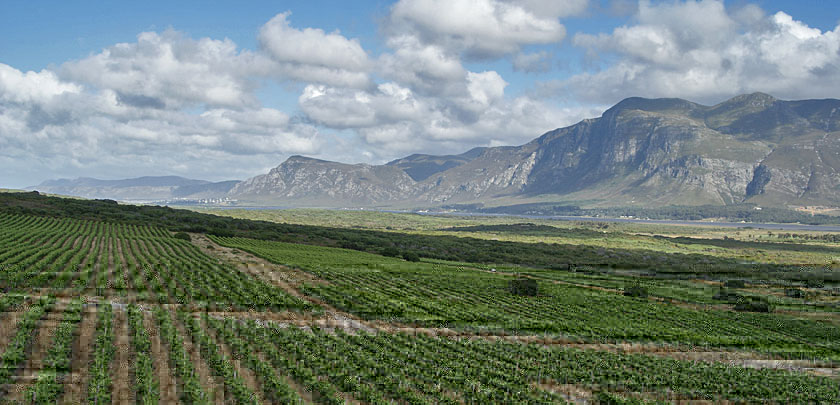
Looking across the vines at Springfontein Wine Estate towards the lagoon and Hermanus

Jennifer & Johst Weber

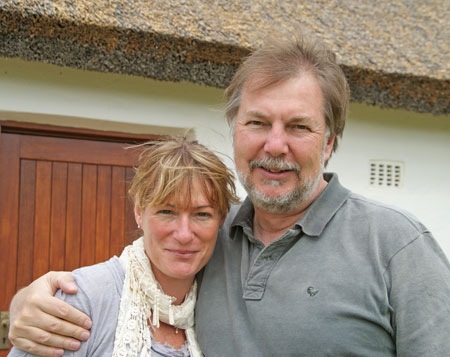
Jennifer & Johst Weber

Johst Weber always had the aim that by the time he was forty he would start a venture of his own, something he could be truly passionate about.

A second generation mining engineer in Germany’s Ruhr Valley, he was an executive at the Thyssen Group, responsible for facility management.  After Thyssen he started an energy contracting business which provides cost-effective energy solutions, and operates in Germany and the USA.

With his passion for wine, acquiring a wine estate was an obvious choice.  Farms in the more established areas were too pricey and then he heard about a farm that might be for sale outside Stanford — not a known wine-growing area of any note although estates in the Hemel-en-Aarde Valley nearby were already very highly regarded.

Visiting the farm, he found it was occupied by a few cows and goats, and a solitary old man.  The rest was wilderness, but there was a productive spring and a limestone ridge ran through the property which made it ideal for vines.

So, in 1995, he bought Springfontein with a group of friends, retaining the majority share.  The first vines were planted in 1998 and the last blocks completed in 2002.  The first vintage was in 2005.

Vines cover 25ha of the 500ha property.  The vineyards are made up of 80% red varietals such as Cabernet Sauvignon, Petit Verdot, Shiraz, Pinotage and Merlot, and 20% white varietals such as Sauvignon Blanc, Chenin Blanc, Semillon and Chardonnay. The two flagship wines of the winery are two typical South African varieties namely the Jil’s Dune Chenin blanc and the Jonathan’s Ridge Pinotage.

Jennifer, Johst’s second wife, has brought a new focus and energy to the estate.  From the USA, she grew up in farming communities and trained in France and Germany on biodynamic farms.  Her first business was landscaping in California which she ran for six years.  When her marriage ended, she needed to earn more money and started consulting as a systems advisor and business coach, working for HP, BMW, Mercedes-AMG and Audi in Germany.  Her last projects as sales and technical trainer finished in 2011.

Together they bring the determination and competence to make Springfontein a winning destination in its own right.  The appointment Tariro Masayiti as winemaker last year started a new and very exciting chapter in the wines from the estate.  The arrival of Jurgen & Susanne Schneider from Germany this year to open a restaurant on the estate later in the year will make Springfontein one of the most compelling destinations in the area.  Farm accommodation in the Milkwood forest will follow later.

And it’s not just about the estate and how they treat staff there, they are also committed to making a difference in the wider community.  They are exploring the possibility of opening a culinary academy in the town where students will get their practical experience at the estate’s restaurant.

They may have just been known for their wines up to now, but Springfontein is about to become far more than that in the coming months…


Posted in Uncategorized | Tagged , , , , | Leave a comment
Bea Whittaker

Bea Whittaker — few have worked harder for the village

Bea Whittaker has boundless energy and is another stalwart of the various civil society organisations in the town.  Today she is the independent member of the ward committee, which means she can’t serve on the committee of any organisation.

But that doesn’t stop her getting involved in anything that will benefit Stanford.

Bea and Basil Whittaker came to Stanford in 1994.  “Basil had a plot at De Kelders and we stopped at Stanford en route, admiring the vista to the mountains.  I was working at Parliamentary Services in Cape Town and we were thinking about a home for retirement.  We took photographs and came back on holiday, and bought our first house on the Market Square.”

Then Marlene (Marlene’s Properties and another stalwart) told Bea that Stanford House was looking for a couple to manage the hotel.  Impulsively they resigned from their demanding jobs — and the holiday home became a permanent home.  In 1995 she joined Marlene and Mariana Esterhuizen on Stanford’s tourism committee, as they wanted to put Stanford on the map.  “It was much more informal then.  Things just got done… it was much easier before the establishment of the cumbersome Overstrand Municipality.  Now, municipalities are ruled and regulated to inertia,” she says.

In the mean time, in 1996, the Department of Water Affairs (DWA) started the Hermanus Water Conservation Project and Bea, having just started her Milkwood Communications business and having worked for the Department before moving to Stanford and a MBA behind her name, was the ideal person to appoint as project manager for the four-year project.  It achieved worldwide recognition as the first successful municipal water conservation and demand management project in the world.  She consulted on various other similar projects in South Africa.  Her project management and communications skills also took her to Ethiopia in 2000, where the World Bank asked her to draw up a communications strategy for the Addis Ababa water authority – an experience and country never to forget.

But between managing and running her own company with demanding projects, she still had (and still has!) time for Stanford.  In 1996 she joined the Stanford Conservation Trust, which was established by Peter de Villiers, David Evans and Mariana in 1991.  Stanford’s core was proclaimed a Conservation Area through the efforts of these three Stanford stalwarts.

Next she raised money from the DWA and the Department of Agriculture and more than 70ha of alien vegetation was cleared in the area around The Eye and next to the river in a four year project, employing more than 70 people.

Bea became chair of the Heritage Committee and oversaw the publishing of the Stanford Style booklet.  When Stanford turned 150, the committee arranged an entire weekend of heritage events which brought people in from far and wide.  The weekend also raised funds for the Historical Stanford on Foot brochure, another initiative of Bea and her committee. (She also helped SJ du Toit with her books on Stanford.)  In the last year of her tenure as chair she obtained R80,000 from the Roland & Leta Hill Fund for the restoration of the historic Anglican church.  With the church turning 150 this year, she is arranging another black tie event for 20 July 2013 to raise more funds – this time to fix the thatch of the church hall.

She and Basil have for years been involved with the Wandelpad, the brainchild of Mariana Esterhuizen and David Evans, alongside the river.  Twice a week the Wandelpad committee manages a job creation team funded by the Department of Environmental Affairs.  The “Green Team”, as they are fondly known, has worked wonders along the river, and is regarded as the best team in the Overstrand Municipality.  She believes that the riverfront still has to achieve its full potential.

She makes the point that any organisation is only as successful as the person steering it.  “He or she must be a lateral thinker who sees opportunities.”

“Stanford people are lovely people,” she says.  “We may sometimes fight like mad, yet when trouble brews we stick together like glue.  But there is a problem with the village.  It attracts people that are exceptionally successful in previous lives, but too gentlemanly to put up a fight with authorities.  We need more people who will stick their necks out and get involved.”

Bea wants to get the village going… “but there’s no CEO who acts and gets things done.”

She also bemoans the lack of communication.  She writes about ward committee meetings and other issues in every issue of River Talk — the local monthly magazine, which primarily reaches the more affluent residents.  But there are many committees which don’t provide any public feedback, and “people want to know what’s happening without being a member of the organisation.”  Tourism, Ratepayer and Conservation Trust could share much more.

Some might find Bea pushy or bossy, and I might have been a little intimidated by her had I not discovered that she’s Arie Burggraaf’s sister.  Then everything fell into place.  I got to know Arie in 1986 when he was appointed to chair a committee to look at opening up SA harbours for commercial development — one outcome of the 1985 Pierhead Festival I organised which regained public access to Cape Town’s docks  for the first time since 1966 and the Suez ‘crisis’.

Arie went on to become a director of the V&A Waterfront company and I worked with him until 1999.  (The Waterfront story published on CapeInfo is actually based on a paper I prepared for Arie.)  Some people found Arie pushy… but the Waterfront would never have happened without him.  He saw opportunities and ways around obstacles.  And he was tenacious.

Stanford doesn’t know how lucky it is to have someone of Bea’s calibre and commitment.


Posted in Uncategorized | Tagged , , , , , , , , , , , , , , , | 4 Comments
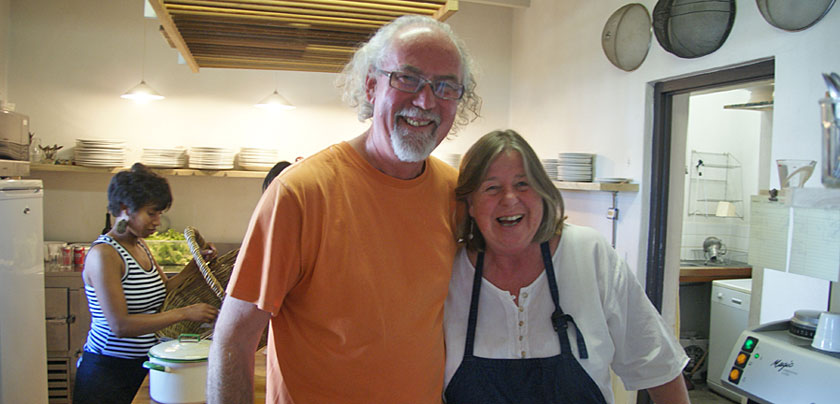
    Peter & Mariana Esterhuyse in the kitchen of Marianas, which put Stanford firmly on the foodie map.

Peter & Mariana Esterhuizen in the kitchen of Marianas, which put Stanford firmly on the foodie map.

Very few people get to choose the lifestyle they want to lead and actually manage to hang on to it.  But Peter & Mariana Esterhuizen have achieved just that.

The fact that Marianas is named as one of the top country kitchens year after year has less to do with it the lifestyle Stanford affords.

“Mariana  and I were at school together,” Peter recalls, “but we actually met when we were three years old!  So it’s been a long relationship.”  They were married in Stanford in 1981, because Mariana’s parents had a holiday house at nearby De Kelders, but at that stage they had no thoughts about moving to Stanford.

Then in 1983 they had their first uninterrupted three week holiday, at De Kelders, and started thinking about moving from Cape Town to the country.  They looked at all the small towns, like Barrydale, which have become so popular with city people since then.  Their criterion was “What do you do on a Sunday afternoon when the wind blows and it’s miserable?”

The next challenge was how to make a living in a small town.  Mariana worked as a translator at Parliament and Peter was in the music industry.  Then Mariana’s father suggested to Peter he might need to learn a trade and so he learnt to be be an electrician at an adult training centre, culminating in an intensive apprenticeship at the City of Cape Town.  Stanford proved to be a good spot to ply his new-found trade.

Mariana devoted her energies to planting vegetables and before long she had a glut of produce.  And that led them to the weekly Hermanus market which at that stage only had ten stalls, eight of which sold food.  They spent twelve years at the market and it was there that they established a loyal client base that was second to none.

“The market was a party… and hard work,” says Mariana.  “We gave people what they wanted — organic vegetables, pesto, tapenade (long before it was seen anywhere else in SA), pies and breads.  When we got to the market each week, we’d find people already waiting for us and by the time we finished unpacking the van, there were nine people abreast and 15 deep.  We sold out in two hours!  After three or four years we had a cult following.  I was really proud of that market.”

Regulars like Gerrie Heynecke would arrive with a bowl to be filled for lunch back home for his guests and family.  “It was all very social.”

She names Hennie & Jennie van der Bijl with their fresh asparagus and home-made butter,  oom Boetie Arendts who sold fresh vegetables and cooked soup for lunch on a Primus stove and Kathleen Barendse , a third-generation veteran who had started at the Old Harbour market, as the mainstays.

“There was camaraderie and good products,” she says.  Peter was the chair of the traders’ association.  Then the municipality, due to pressure from prospective traders, created more stalls and the squabbling started.  It became more of a fleamarket and when they left after 12 years there were 280 stalls with only two selling food.  “They wanted to preserve history but they killed the heritage.”

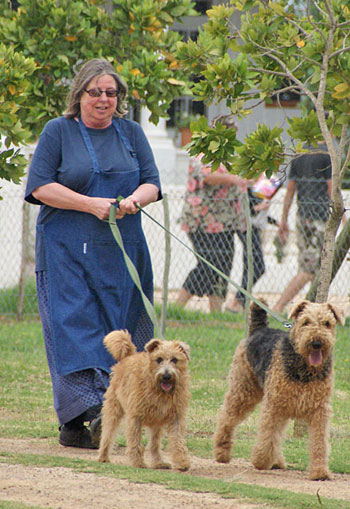
Either Peter or Mariana walking the dogs is a frequent sight in Stanford.

Either Peter or Mariana walking the dogs is a frequent sight in Stanford.

Life in Stanford itself was also rather special.  “In small towns one gets involved in community activities.”  Stanford had its own municipality with a mayor and five councillors.  It was controlled by the Nationalist Party, who played hardball and dirty during elections but were magnanimous in victory.  Things got done in the town quickly and pragmatism was the rule of the day.  It was a happy town pre-1994 and the new era of super-municipalities.

If municipal politics in the ‘old days’ was a religion for some, for others it was an anti-establishment sport with a social conscience.  Mariana and a few others stood as independents.  For the first democratic elections, when they realised they needed a logo, a symbol of a tree was hastily scribbled… and they became known as the “Boom Party” and “were trashed by the Nats,” she recalls .

When the Stanford Transitional Council was being established in 1992, the challenge of bringing diverse groups together met a snag.  Peter, Mariana and Gavin Carstens, with an interpreter, headed off to De Kop (the Black squatter camp) to find a solution, and asked to speak to someone in charge.  Back in town, at the following meeting, they were accused by the late Jan Stander of creating both the ANC Women’s League and the ANC Youth League!

After almost 30 years in the village, between them Mariana and Peter have served on virtually every committee that addresses village affairs.  Listening to the stories is like a roll call of people who influenced the village — Dick Metcalfe, Mike van Rijn, Brigadier Laurie van Vuuren, Jan Stander, Henry Gibson, Willem Appel, Naas Bojé, Gavin Carstens and Hermie Lategan.  Village issues were fiercely fought and sometimes ended in the Supreme Court, with bon vivant Advocate Allie Blommaert taking on one of the cases.

When author SJ du Toit (two volumes of Stanford Stories) won an award and was invited to Johannesburg to receive it.  She was extremely excited, but could not afford the expense of travelling to Johannesburg.  That evening Peter and Mariana went to the local pub and put R100 on the counter and asked others to join in.  SJ’s ticket was covered and property agent Jill Smith found a place for SJ to stay.   Stanford is a village that looks after its own.

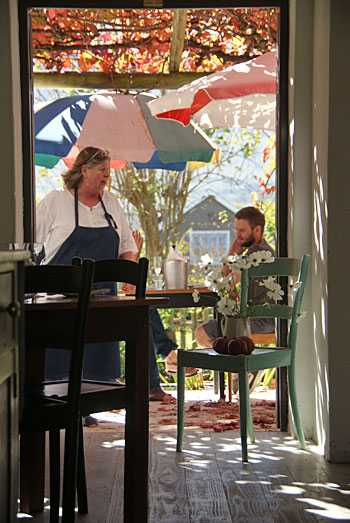
And what about Marianas, the restaurant?  The change 13 years ago from the deli in Owl’s Barn — selling lettuces and quiches, with a few deli goods, and catering for the odd table — to a restaurant took a fortnight.   It has been voted the top country kitchen in SA and Rossouw’s Guide rates it highly for consistency.

Eat Out describes it:
Food:
image35 There’s a lovable quirkiness to the menu at this Stanford institution, yet the dishes that flow from Mariana Esterhuizen’s small kitchen are as homely as could be. Ingredients are sourced locally or straight from her own herb and vegetable garden. Tuck into slow-roasted ‘skaap and dinges’, tender ‘oink neck’, a wonderfully light gruyere soufflé, or her justifiably famous chicken pie made from the most liberated of free-range birds. Delightful country cooking where nothing will disappoint.

Wine:
A small yet carefully selected list of estates, both local and from further afield, with a handful available by the glass.

Service:
While Mariana cooks up a storm, her husband Peter welcomes guests and explains the day’s dishes. There’s a warm, personal touch that’s missing from so many eateries.

Ambience:
A quaint home-style restaurant with a few flourishes. By and large it’s a relaxed setting crying out for languid lunches.

And…:
Reservations are essential, especially during holiday periods. (RH, October 2011)

Marianas is only open from Thursdays to Sundays between noon and 4pm.  Wednesdays are preparation days in Mariana’s kitchen at home — across the vegetable garden from the restaurant.  And Mondays and Tuesdays are Peter and Mariana’s weekend.

At the end of a very long interview, and much wine, Mariana spoke about the glue that holds everything together — Peter’s amazing ability to welcome guests and put them at ease in a signature way that few people ever achieve.  “Peter is… my saving grace…”

Posted in Uncategorized | Tagged , , , , , , , , , , , , , , , , , , , , , | 3 Comments